Archives for the month of: July, 2011

They are some frankly pretty cook kids, indeed.

This Friday, where I am, means another long weekend! I’m using the free time to make shirts for a wicked music festival next weekend. But, before the weekend comes is the work week and the work week’s musical accompaniment. Here are some highlights.

The Cool Kids

Gold Panda

Ohbijou NEW NEW NEW Yessss!

For people in a different sort of listening mood, I highly recommend Dan Carlin’s Fall of the Roman Republic – a pretty engaging 10 hour free audiobook about, obviously, the fall of the Roman Republic.

Have a great weekend, long or otherwise!

Just like Johnny Mnemonic... look at him!

People have been murmuring  that the Internet is “ruining”  our memory for a while. Ruin? I don’t know. Recent studies have shown that since the advent of the Internet our memory practices have been evolving and that this is also reversible.

Whether you think it’s a bad (Luddites!) or a good thing (non-Luddites! or normal people or “norms”), there is a change taking place in how Internet users combine their brains with the information on the web.

From Scientific American:

Led by Columbia University psychologist Betsy Sparrow, the researchers conducted a series of experiments whose results suggest that when people are faced with difficult questions, they are likely to think that the Internet will help them find the answers. In fact, those who expect to able to search for answers to difficult questions online are less likely to commit the information to memory. People tend to memorize answers if they believe that it is the only way they will have access to that information in the future. Regardless of whether they remember the facts, however, people tend to recall the Web sites that hold the answers they seek.

In this way, the Internet has become a primary form of external or “transactive” memory (a term coined by Sparrow’s one-time academic advisor, social psychologist Daniel Wegner), where information is stored collectively outside the brain. This is not so different from the pre-Internet past, when people relied on books, libraries and one another—such as using a “lifeline” on the game show Who Wants to be a Millionaire?—for information. Now, however, besides oral and printed sources of information, a lion’s share of our collective and institutional knowledge bases reside online and in data storage…

And if our gadgets were to fail due to a planet-wide electromagnetic pulse tomorrow, we would still be all right. People may rely on their mobile phones to remember friends’ and family members’ phone numbers, for example, but the part of the brain responsible for such memorization has not been atrophied, she says. “It’s not like we’ve lost the ability to do it.[source]

Neat, right? The world is catching up with librarians in this respect. We’ve been using our collections, catalogues and reference tools (digital or physical) as prosthetic memory contraptions since always. The Internet for some is a revolutionary change in how people remember and access information. For LIS professionals it’s one new step in an ongoing evolution.

Read the rest of this entry »

Okkervil River are in your backyard, maybe.

Well… heat wave…. enough said. At least work has AC. So I’m happy to be here and cool in my cubicle. Here’s what has been in my ears this week.

Cults (easily a front runner for my Album of Summer 2011)

Okkervil River (an exciting return)

Phoenix (Album of Summer 2009)

Have a great weekend. Try and stay cool. (Hints: Visit your public library! Or get thee to the beach!)

Toronto Mayor Rob Ford: giver of cuts or promises of cuts or promises of cuts then paying more.

The Toronto Public Library (Canada’s largest library system) has recently been threatened with cuts. Having already seen one branch take a hit, the city’s library workers and supporters are taking a hard line. In brash awesomeness, they’ve issued a warning to city councillors looking to wield a heavy knife.

The Toronto Public Library Workers Union has a message for city councillors: If you want to keep your seat, support your local libraries.

Results of a survey commissioned by the union and released Wednesday found that half of Toronto residents said it would affect their vote “a great deal” if they knew a candidate had supported closing a library branch.

The survey sends “very clear” message, union president Maureen O’Reilly said. Of more than 1,000 respondents, about three-quarters said they disagreed with closing branches to save money. The library board recently approved a $184 million budget that led to a decision to close the Metro Hall branch. “We have no reason to believe this trend won’t continue,” O’Reilly said, adding that shutting branches adversely affects seniors and kids.[source]

The numbers seem to be in the TPL’s favour:

This message emerges from a Forum Research poll conducted on July 4, 2011 which found that three-quarters of Toronto residents disagree with the idea of closing local library branches as a way of solving the city’s deficit (74%), and more than one half disagree “strongly” (54%). When it is their own local branch which is threatened, the proportion of those who “strongly disagree” increases to two-thirds (64%).

Not only are library branch closures off the table as far as Toronto residents are concerned, more than half disagree with privatizing the delivery of any city services (55%), and more than one third disagree “strongly” (38%). When the Toronto Public Library is mentioned as a privatization target, seven-in-ten Torontonians disagree (71%), more than one half “strongly” (55%).[source]

Hopefully, this sort of information will make the budget hounds think twice.

Torontonians can take action by contacting their city councillors and/or by signing the online petition.

Lousie Burns is of the forest.

Friday’s here! My workday soundtrack has been filled with a couple epic moments. For instance, my geeky prog-punk-metal heart as obliged me to attempt Coheed and Cambria’s space epic, which I didn’t not get all the way through (… it’s like 5 albums! And really cheesy…). Here are a few of my less serialized (maybe less epic) pics form this week.

EMA

Louise Burns(a great new find via the Polaris Long List.)

The Wooden Sky

Have a great weekend, everyone!

The Globe and Mail had an article yesterday about the Canadian Federal Government upgrading the “Working in Canada” website to “let Canadians know what jobs will be required in the long term so students who are planning their education can look ahead and plan their careers.”

The good database-friendly librarian that I am, I went to take it for a test spin using an obvious keyword. Here is the result for “librarian“:

Librarians (NOC 5111-A)

Librarians select, develop, organize and maintain library collections and provide advisory services for users. They are employed in libraries or in a department within a library.
Included job titles: bibliographer, cataloguer – library, cybrarian, librarian, library consultant, library
supervisor.

There is related result for library managers, too. It is possible to think that this description is a little lacking. To be fair the description of essential skills is not too bad, but it’s a little sterile in my opinion. As a Data-fixer, the closest (non-librarian) job description is Database Analysts and Data Administrators. Right now, I’d say I’m somewhere between librarian and that.

This has me thinking about how I describe what I do to people I meet and potential employees.

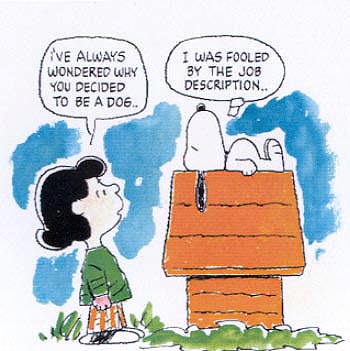
What librarians do is important and relevant, but there is a sense that the name is still left in the dusty book shelves of old preconceptions. And, the job description the Feds are using  doesn’t look like it’ll help break down those stereotypes. Moreover, for people looking to sell themselves to employers or for employers looking to find people that can do what LIS people do, it’s really not that helpful.

There is something to the “Librarian” brand that we can and do capitalize on. I’ve watched the on-going  dialogue about the librarian term and new terms that are creeping into our job titles. I am totally fine with this.

If you think about it, I could just as well be a “Database Analyst”, but I prefer “Librarian.” This is perhaps because it signifies something greater, perhaps a commitment to values or a connection to a tradition of practice. Other job titles just don’t seem to carry the same weight.

I heard about Jane McGonigal and her book Reality is Broken: Why Games Make Us Better and how They Can Change the World through a radio doc on CBC’s Spark.

She also has a TED talk.

Is this something libraries can get in on? Libraries have always been a sort of augmented reality tool (using analogue books (old fashioned information access) and now with more high-tech Internet based tools). It’s only one more step to add a game layer. The NYPL’s Find the Future is an example that combines learning and adventure through a mix of the physical library and laptops or smartphones. Gaming and reality are no longer so separate.

McGonigal may come off as a little optimistic, but she’s pushing an emerging idea. You can check out some of McGonigal’s games here.

What through video games is possible? Collaboration and crowd-sourcing scientific research? Breaking down social barriers? I don’t know if video games and gaming CAN solve all our problems. I do think that it is necessary to rethink radically what we can accomplish since it’s a media form that has pretty much overtaken EVERY other media we’ve ever come up with.